
Somerset Scheduled and Actual Release
A projected date is the custodian's current estimate based on the sentence and the credits then recorded. An actual release date is the date the facility completed the person's movement out of its custody. Those facts can diverge. Credits may be earned, revoked, or restored. A court may amend a commitment. Another jurisdiction may lodge a hold. Parole processing may also remain unfinished when an eligibility or approval date arrives.
Pretrial custody works differently. A person awaiting trial at Somerset County Detention Center has not begun a final sentence merely because the person is in jail. Bond, recognizance, dismissal, a plea, sentencing, or another court order may end local detention. The court docket can show the legal authority, while the Somerset County Detention Center movement record shows when the physical exit occurred and whether it was a community release or a transfer.
Somerset Projected Release Date Form
Somerset publishes an unusually specific local detail. The detention center brochure says sentenced inmates receive a document called the “Projected Release Date Form.” The brochure does not publish a blank copy, describe each field, or disclose the calculation sheet. It also states that friends and family may obtain the information from the inmate, while detention staff are not permitted to give projected-release information to the general public.
That access rule shapes the correct inquiry. A person who is in direct contact with the sentenced inmate can ask for the date shown on the inmate's copy. A person seeking an agency record can submit a narrow Maryland Public Information Act request for the existing calculation record, subject to lawful withholding or redaction. The request should not demand that staff create a fresh answer or calculate a new date.
The form belongs to the county-jail process. Eastern Correctional Institution is a Maryland Division of Correction prison, even though it sits nearby on Revells Neck Road. A state-prison calculation must be requested from the Maryland Department of Public Safety and Correctional Services, not Somerset County Detention Center.
Note: Use the exact facility name in every request because the county jail and state prison are separate custodians with separate release records.
Find a Somerset Projected Date
Start with the type of custody, not a broad name search. The public DPSCS Incarcerated Individual Locator can help identify a covered person who remains in state custody, but it does not publish a projected or tentative release-date field. It also omits people no longer in custody. A missing result cannot confirm release. For a Somerset County jail sentence, use the local form and record route. For an ECI or other Maryland prison term, seek the state commitment and release-calculation record.
- Confirm the custodian. Determine whether the person is at Somerset County Detention Center, Eastern Correctional Institution, another state facility, or a different system. Match the name with a court case or known identifier.
- Read the sentencing record. Use Maryland Judiciary Case Search and the court file to find the aggregate sentence, commitment date, time-served credit, and any later modification. A docket explains the legal basis but may not show the facility's live calculation.
- Use the correct calculation source. Ask the sentenced SCDC inmate for the Projected Release Date Form or request the existing calculation record. For a state prisoner, submit the inquiry through the DPSCS records channel.
- Separate eligibility from scheduling. Treat a parole eligibility date, hearing date, approval, approved home plan, scheduled date, and physical exit as distinct events.
- Confirm the completed release. Obtain the actual movement or discharge record from the custodian. A VINE alert can add notice, but the releasing agency's record controls the meaning of the event.
The broader Somerset County released-inmate search explains how to reconcile the court order with the custody movement after a person leaves a live locator. That two-source check prevents an estimated date from being reported as a completed release.
Maryland Credits Shape Somerset Release
Maryland calls sentence reductions “diminution credits.” For state prisoners, Correctional Services Title 3, Subtitle 7 provides several types, including good-conduct, work-task, education, and special-project credits. The applicable amount turns on the offense, offense date, sentence structure, statutory exclusions, the work or program involved, and the person's credit history. Local correctional sentences have a related but separate framework under Correctional Services § 11-502.
Correctional Services § 3-704 provides a standard advance good-conduct deduction of ten days for each calendar month, prorated for a partial month. The rate is five days per calendar month when the aggregate term includes a concurrent or consecutive sentence for a defined crime of violence or specified serious drug offense. Some periods, including escape time and other periods for which sentence credit is unavailable, do not generate that deduction.
Other credits have their own rules. Section 3-702 contains offense-specific exclusions. Section 3-707 addresses special-project credits, and § 3-708 caps combined credits at different monthly levels for defined groups. These parts must be applied to the actual commitment. A generic web calculator cannot safely resolve them. The official § 3-708 text shows why the final computation depends on more than one rate, and the linked Maryland statute provides the governing cap language:
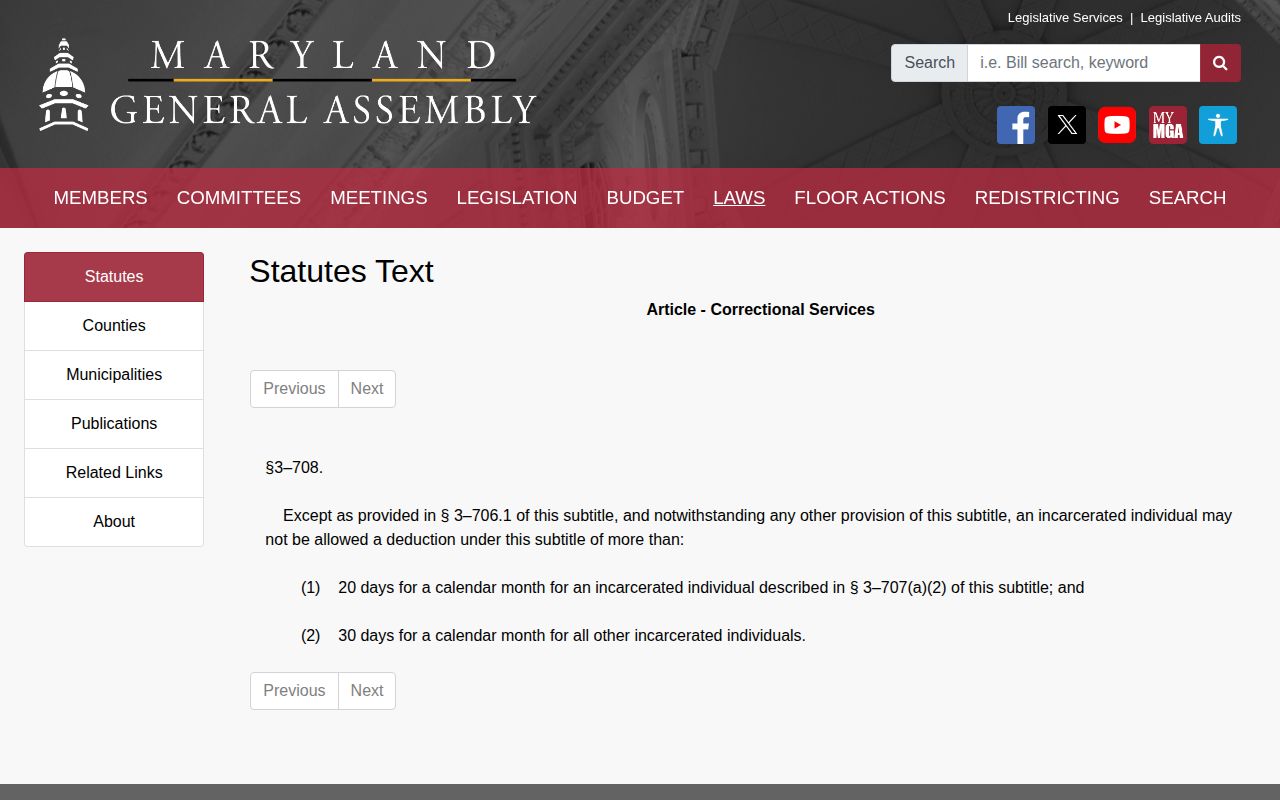
The statute is one input to the Somerset release-date record, not a person-level calculation by itself. The custodian's computation must account for each credit category and every applicable limit.
No Universal Somerset Release Percentage
Maryland does not have a sound universal answer that everyone serves 85 percent. That shorthand can hide the difference between a five-day monthly rate and a percentage of a particular sentence. It also ignores other credit classes, statutory caps, exclusions, offense dates, jail credit, concurrent or consecutive terms, and credits later revoked or restored.
A defensible Somerset County projected release date begins with the court's aggregate sentence. The custodian then applies credit for time already served when authorized, calculates only the diminution credits allowed for the commitment, checks any lost or restored credits, and applies restrictions tied to parole or mandatory supervision. For a local sentence, the SCDC form reflects the facility's calculation. For a state sentence, the DPSCS calculation record is the relevant source.
- Aggregate sentence
- The combined term produced by the court's concurrent and consecutive sentence structure.
- Diminution credit
- A lawful deduction that reduces a term for release purposes under the governing correctional statute.
- Mandatory supervision
- A conditional state release before maximum expiration that results from applied diminution credits.
- Detainer
- A request or notice from another authority that may lead to transfer or continued custody after the local basis ends.
What Changes Somerset Release Dates
A release calculation is revised when its inputs change. Some changes move the date later, while others may move it earlier. A projected date should therefore be recorded with the date on which the agency supplied it. When an updated date conflicts with an older form, ask the custodian for the current calculation and the record of the adjustment.
| Factor | Possible effect | Record to check |
|---|---|---|
| Credit earned or restored | May advance the projected release date within statutory limits | Current SCDC or DPSCS credit calculation |
| Credit revoked | May move the projected date later after discipline | Credit ledger and final disciplinary decision |
| Amended court commitment | Can change the base term, sentence structure, or jail credit | Court order and revised commitment |
| New sentence or detainer | May continue custody or cause a transfer after the first term ends | Movement record and receiving-agency notice |
| Parole decision | Approval may create a path to conditional release, but conditions can delay exit | Commission decision, home-plan status, and discharge record |
| Escape or other noncredit period | Can stop credit accrual for the period defined by law | Custody chronology and official recalculation |
Preserve the agency's own status words. “Eligible,” “approved,” “scheduled,” “released,” and “discharged” do not mean the same thing. A transfer from SCDC to ECI also is not a release to the community, even though the person has left the county jail.
Note: A projected date that arrives without the facility name and calculation date is too incomplete to treat as a current schedule.
Somerset Parole Is Not Release
Parole eligibility marks the first point at which the Maryland Parole Commission may consider release under the applicable law. It is not a promise of release. Under Correctional Services § 7-301, the ordinary starting rule for a sentence of at least six months is eligibility after one-fourth of the aggregate sentence. Crimes of violence, combined sentence types, life sentences, repeat serious drug provisions, and offense dates can produce different thresholds.
Even after approval, prerelease conditions may remain. The person may need an approved home plan or required programming, and institutional conduct can affect processing. Keep the Commission decision, any planned date, the approved release conditions, and the actual DPSCS discharge as separate records. Mandatory supervision is also distinct: qualifying state prisoners may be conditionally released after subtraction of credits under § 7-501, subject to the statute's restrictions.
Confirm Somerset Actual Release
After the projected date arrives, confirm the outcome with the custodian that held the person. For Somerset County Detention Center, request the actual release or transfer date and time, disposition, releasing authority, and receiving agency if one exists. For Eastern Correctional Institution, request the DPSCS release, discharge, or transfer record. If VINE reports a custody event, compare it with the facility record because notification time may reflect data transmission rather than the moment of physical exit.
A court docket can explain why release became lawful, but it is not the jail's movement log. Likewise, the DPSCS locator is designed for current custody and removes people no longer held for any reason. Its silence cannot distinguish release from escape, a name mismatch, limited coverage, or movement into a different custody system. The final answer comes from reconciling the legal order with the actual custody record.
A narrow written request should identify the person, the facility, the court case when known, and the relevant custody period. Ask for the existing calculation, release, discharge, and transfer records rather than a newly composed explanation. Electronic delivery can reduce copying, and a request for a fee estimate lets the custodian flag chargeable work before it proceeds. If part of the record is withheld, ask for the legal basis and any reasonably severable portion that can still be released.
The resulting chronology should show each event on its own line: sentence and time-served credit, calculation date, projected date, any credit adjustment, parole action when relevant, the final scheduled date, and the actual exit or transfer. This format makes later changes visible. It also prevents a Somerset County projected release date from being confused with a court hearing, parole eligibility point, or notification timestamp.